Ground Fault Notes
R. Kwas KA1-RBP Jun2016
------------------------------------
Note: Ground Fault Protection is NOT Safety Ground Protection!
I use the term GFI for Ground Fault Interrupter...not GFCI... that it is in a Circuit is obvious and doesn't need to be restated!
------------------------------------
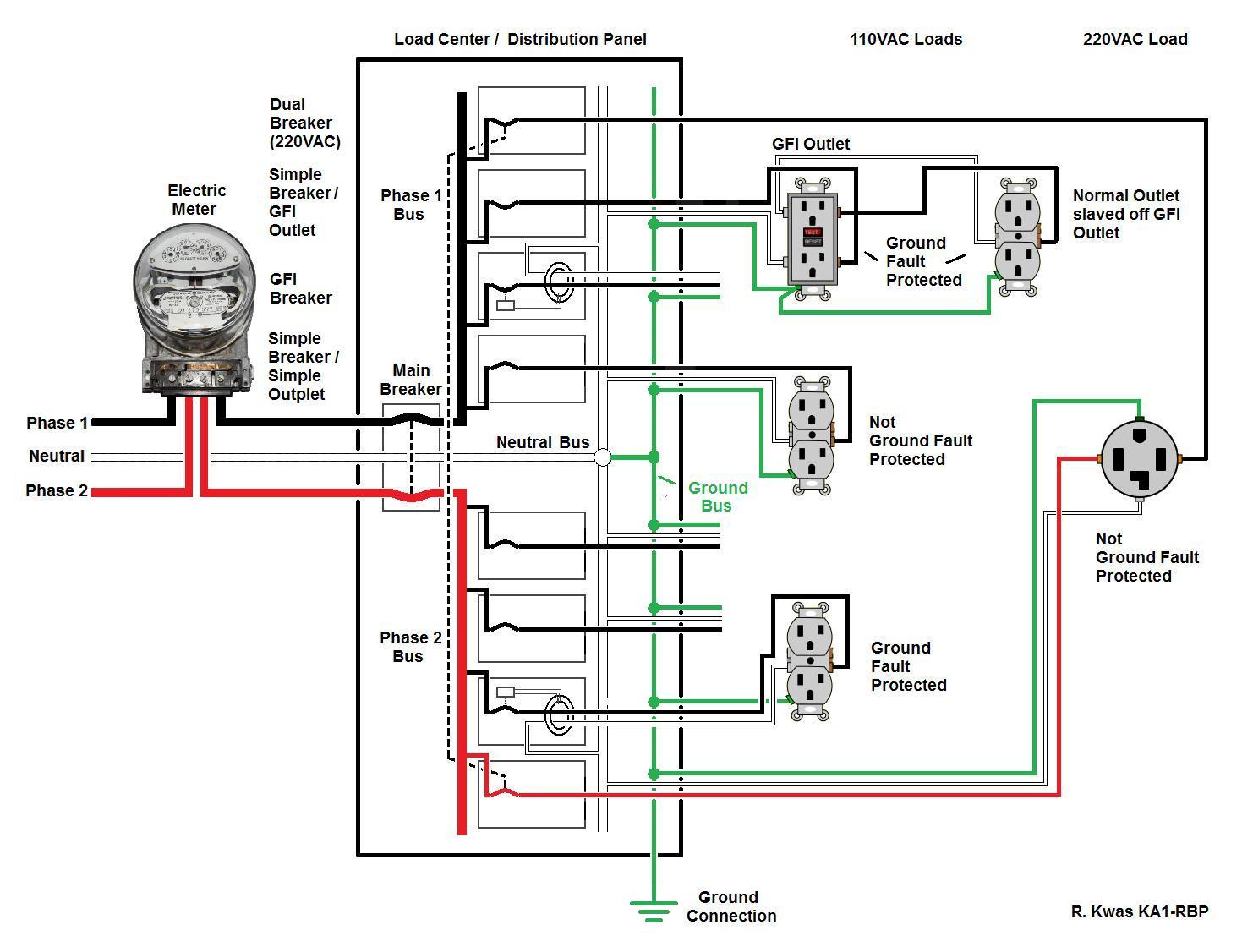
Ground Fault Protection can be achieved several ways as shown below...either with a GFI Breaker which protects the entire sub-circuit, by means of a GFI Outlet which protects at that location and any Slaved Outlets downstream. 220V Circuits for spas or hot-tubs can also have GFI protection.
Typical US domestic power distribution with variations of non-GFI and GFI shown:
Ground Faults occur when the current returns to Neutral bus, by some path other than the neutral conductor of the circuit. Since this will be by means of the Ground conductor, and it is by definition a Fault condition, it is is called a Ground Fault.
Ground Fault Interrupters (GFI Circuit Breaker or Outlet types) sense this by using a small Current Transformer as shown. Both Hot and Neutral wires are routed through the transformer core, such that when load current is drawn, it results in a net induced flux of zero (balanced!) under normal, non-fault conditions. If however current finds an alternate path to neutral, which might involve a person, there would be a flux induced in the sensing CT because of the imbalance in currents, which upon being sensed, would cause the breaker/GFI outlet to trip, preventing electrocution.
Power Distribution with possible Ground Fault paths indicated. Only those which are downstream of a Breaker or Outlet with sensing are protected against Ground Faults.

------------------------------------
GFI sensitivity to RF. GFI sensing circuits are generally filtered to prevent nuisance trips when subjected to RF such as what an radio amateur station might be emitting. Occasionally however, a particular GFI outlet, or installation, or the level of RF we produce and which gets into the control circuit (maybe the sensing transformer is acting like a ferrite AM antenna, and circuit has inadequate filtering for RF!) is enough to trip the GFI function. Mitigation suggestions: PLACEHOLDER
------------------------------------
Installing a GFI outlet into an old construction Bathroom.
After consulting with Tom M. (licensed electrician, and highly experienced electronics engineer whose judgment I respect), who pointed out that installing one of these is still a good upgrade because it adds Ground Fault Protection, even though there is no Safety Ground Protection (the two are related, but very different!), I proceeded with installing a GFI outlet into an old construction bathroom. He also noted that since there is no Safety Ground conductor present, Test button on GFI outlet would not work, but this can be explained to any inspector questioning it (and he apparently has needed to), and is "grandfathered in" because of the old/existing construction.
After installation of the GFI outlet was completed, I tried the Test button, and in fact it did function to trip the outlet as it is supposed to...this was not what I expected and inconsistent with Tom's statement, but after a moment of consideration, I could explain it. This explanation is illustrated in some cocktail napkin engineering here:
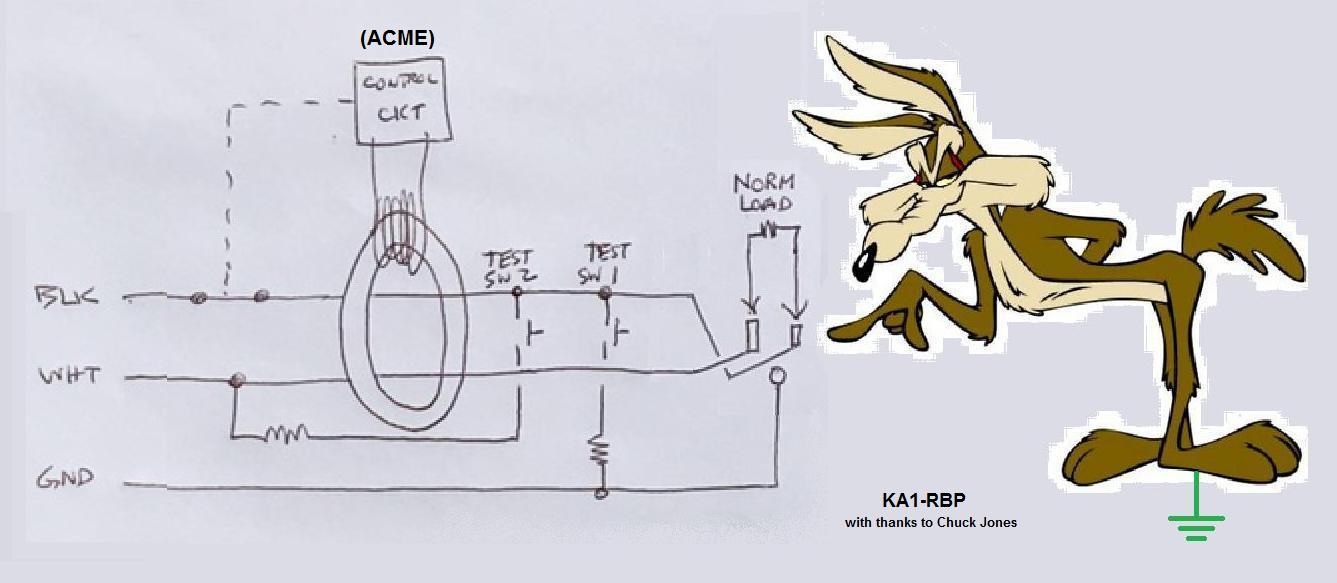
Test Switch 1 and its' current path requires continuous Safety Ground to the new
outlet, because it returns the test GF current to the Safety Ground, which it
obviously can't if none is present...so if
Test Switch 1 is connected as shown, Test Function would not
work as Tom points out. ...but Test Function does work with no
Safety Ground conductor...so only one explanation is possible: Test
Switch must be connected as shown for
Test Switch 2, with Test Ground Fault current being returned to Neutral wire on
other side of
sensing transformer, such that a valid test GF current (and imbalance in
sensing transformer) is still created when
pushing Test Button, even without a Safety Ground present, and this trips outlet as
expected.
This discussion affects ONLY GF Test function...in both cases actual GF
Protection is present and functional...so Wile E. Coyote (Caninus Nervosous)
would be safe in either case!
-------
Discussion between brother Mike and I about retrofitting a GFI outlet into the old construction Bathroom which has no Safety Ground (house is wired in "BX" armored cable, and Polarity Tester shows open Ground).
Mike;
Tnx for link...good info, OK (only) presentation. See my
comments in Blue
Number 1, 3rd bullet point:
note Number 1, 3rd bullet point
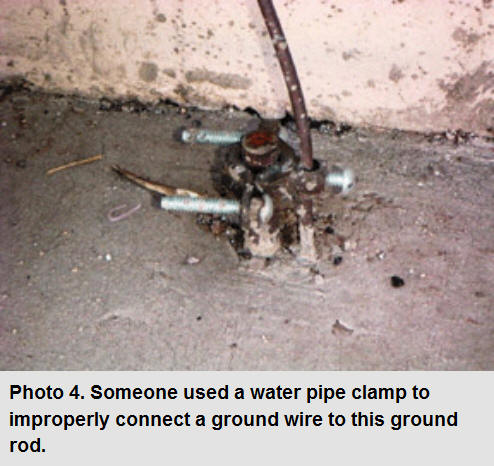
I HAVE TO ASK:
SO WHAT'S IMPROPER ABOUT IT??? What the hell is wrong with this...NOTHING!...It's a solid,
high-current bond to a ground rod!...I don't think the rod or clamp much care
that its a pipe clamp! ...there's just not any ACZP on it to keep the
connection free of corrosion!
------------------------------
External material is attributed. Otherwise, this information is Copyright © 2016-2017. Ronald Kwas, KA1-RBP. The information presented comes from my own experience and carefully considered opinion, and can be used (or not!), or ridiculed and laughed at, at the readers discretion, and jeopardy. As with any recipe, your results may vary, and you are, and will always be, in charge of your own knuckles, and future!
You are welcome to use the information here in good health, and for your own non-commercial purposes, but if you reprint or otherwise republish this article or diagrams, you must give credit to the author and to this site as the source. If you don’t, you’re just a lazy, scum sucking plagiarist, and the Boston Globe wants you! As always, if you can supply corrections, or additional objective information or experience, I will always consider it, and consider working it in...along with likely the odd metaphor and probably wise-a** comment.