Lightning Damage after Near-Strike at Al G's House
R.Kwas KA1-RBP 12/2015
One hot and humid New England August afternoon, thunderstorms had developed and were running through the area. I happened to be with my brother, when he got a phone call from his friend Al G. in the neighboring town. Apparently, a lightning strike had occurred near their house, this had tripped one circuit breaker, which couldn't be reset, and had caused a slight smell of smoke in the house. Mike and I grabbed an electrical tool bag and off we went for some emergency troubleshooting! When we arrived only a few minutes later, the faint smell of smoke was still occasionally detectable, if only barely (this was concerning, but not enough to be useful for locating the source, or calling the fire department!), and the tripped breaker would "crash" (immediately trip again), when trying to reset it, indicating a short was still present on the circuit.
A quick inspection of the Electrical Service Entrance and Load Center showed no immediately obvious damage. There was no Grounding Rod driven into the earth below the meter (grounding was by way of a wire to the cold water pipe in the cellar). My immediate recommendation to Al was to install a Ground Rod under the Meter ASAP (see Points of Note below)...I didn't think the house had taken a direct hit, but a Grounding Rod right at the Service Entrance might have given the surge on the line a better and more harmless path to ground, and place to go, instead of finding one in the house somewhere!
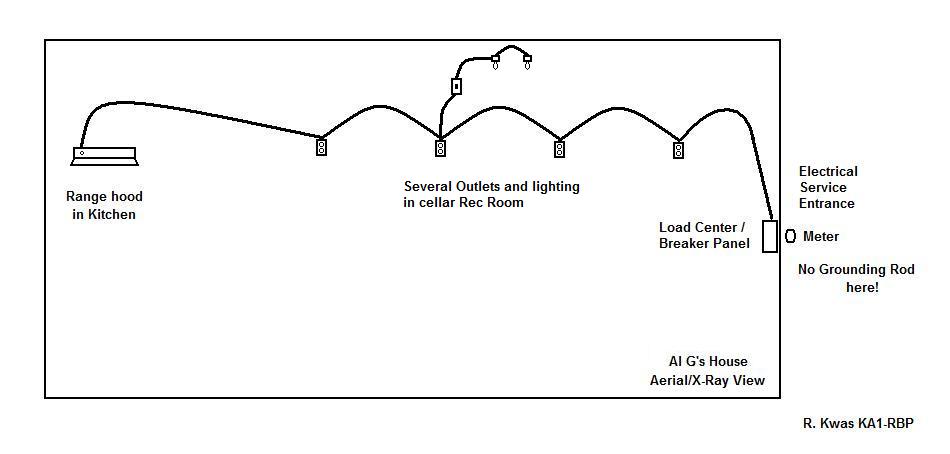
Locating the Short: Since the short was still present on the circuit, I figured the way to proceed, was to follow the dead circuit wiring, giving a "sniff-test" to each box, switch, load or connection involved. We followed the unpowered outlets and lights, pulling the cover off each box, and proceeded through the cellar, recreational room, finally ending up at the opposite end of the house from the Load Center, going upstairs into the kitchen. Checking for what was dead in the kitchen, we found only the range-hood depowered, and our noses confirmed its' switch also had the burnt smell. After disconnecting its' wiring from the line, a short could indeed be measured from Hot to Neutral in the range hood switch.
I was happy (and we were fortunate) to have found this definite short and at the same time source of the burnt smell...sometimes, it is not possible to specifically locate the trouble area, and sometimes, years after the wiring has been first weakened by a long forgotten lightning surge do houses burn! With the range-hood disconnected, and after double-checking all boxes and outlets of the circuit and confirming no burnt smell, we reinstalled their covers, and the tripped circuit breaker could be reset without further issue.
I declared the problem located and the house "Safe". Time on site: 45minutes. I reiterated the recommendation to install a Ground Rod at the Electrical Service Entrance (see Points of Note below). Al G now probably thinks my brother and I are electrical geniuses...when all we did was just used good methodical troubleshooting technique!
Presumable Scenario: A near-strike had caused a surge on one of the phases to the house, and the easiest path for this surge to make its' way to Ground was by way of the Neutral wire in the range-hood switch. A direct strike has enough voltage that it would have been able to hop across any handy spot in the Load Center, but not a mere surge. Its' voltage was not sufficient to hop to a handy ground connection in the Load Center. It sought out the weak link in the circuit, and found this at range-hood, aided by years of cooking grease.
Diagram of problem circuit and location, at Al G's House:
------------------------------
Points of Note:
I don't know much, but I know water likes to run downhill...as a corollary to
that, Lightning also likes to "run downhill"...to ground, and if we don't give
it an easy path, it will find (or make) its' own!
------------------------------
Reference Link:
Mr. Dimock's site is worth a visit! ( http://www.thecircuitdetective.com/index.htm )
------------------------------
External material sources are attributed. Otherwise, this article is Copyright © 2015. Ronald Kwas. The information presented comes from my own experience and carefully considered opinion, and can be used (or not!), or ridiculed and laughed at, at the readers discretion.
You are welcome to use the information here in good health, and for your own non-commercial purposes, but if you reprint or otherwise republish this article or diagrams, you must give credit to the author and to this site as the source. If you don’t, you’re just a lazy, scum sucking plagiarist, and the Boston Globe wants you! As always, if you can supply corrections, or additional objective information or experience, I will always consider it, and consider working it into the next revision of this article...along with likely the odd metaphor and probably wise-a** comment.